巴塞尔指数
注意!该文章为贵州三易医疗器械有限公司原创整理编辑,不经过本公司书面同意,不得以任何方式,包括但不限于电子、纸质的方式进行复制、传播及转载。原始发布时间:2026年8月29日。
巴塞尔指数概况
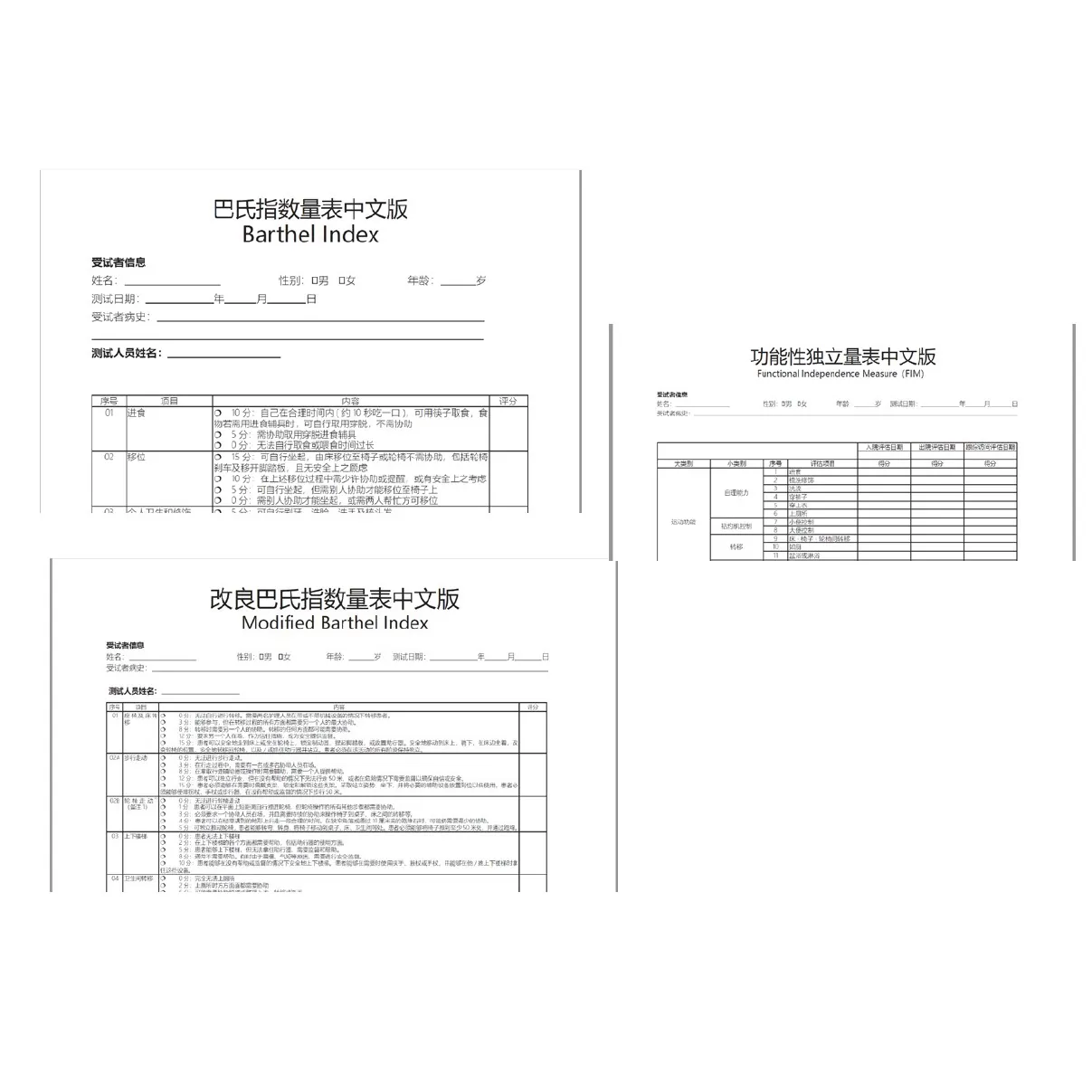
巴塞尔指数(Barthel Index,BI)由Mahoney和Barthel于1965年首次开发,用于测量个体在日常生活活动(ADL)中的独立功能与活动能力,涉及进食、洗澡、修饰、穿衣、大便控制、小便控制、如厕、椅子转移、行走和上下楼梯10个方面。该指数还可提示护理协助需求,是应用广泛的功能残疾测量工具。量表最初为脑卒中及其他神经肌肉或肌肉骨骼疾病康复患者开发,也可用于肿瘤患者。1988年Collin、Wade、Davies和Horne对其进行了修订。
巴塞尔指数的目的
巴塞尔指数旨在测量个体在日常生活活动中能够独立活动的程度,并指示所需的护理协助水平,从而评估脑卒中及其他神经肌肉、肌肉骨骼疾病患者及肿瘤患者的功能残疾状况和自理能力。
巴塞尔指数的测试项目与分量表
原始版本包含10个条目:
- 进食
- 洗澡
- 修饰
- 穿衣
- 大便控制
- 小便控制
- 如厕
- 椅子转移
- 行走
- 上下楼梯
各条目按个体能否独立完成、需部分协助或依赖评分为10分、5分或0分,条目按所需护理水平加权。该量表通常无分量表。
巴塞尔指数的施测规则
巴塞尔指数可通过自我评定、直接观察或电话施测完成,也可由代理人代答。研究表明未经培训与经过培训的人员施测信度相同。75岁以上患者不推荐自评。电话施测也被证明可靠。
巴塞尔指数的评分方法
总分为各条目累加,其中移动能力和二便控制享有优先权重:
- 洗澡和修饰:每项0或5分
- 进食、穿衣、大便控制、小便控制、如厕、上下楼梯:每项0、5或10分
- 转移和活动:每项0、5、10或15分
总分0-100分,分数越高表示功能独立性越高。计分仅需手工简单加总。
Shah、Vanclay和Cooper(1989)提出5级评分修改版:1分为无法完成任务,2分为尝试完成任务但不安全,3分为需中等帮助,4分为需最小帮助,5分为完全独立。其分级标准为:0-20分为完全依赖,21-60分为重度依赖,61-90分为中度依赖,91-99分为轻度依赖。
巴塞尔指数的测试时间
自评需2-5分钟;直接观察最长需20分钟,视患者能力与耐受性而定。
进行巴塞尔指数测试之前需要进行培训吗?
施测无需培训,熟练与非熟练人员施测信度相同。量表可自评,但75岁以上患者不推荐自评;也可通过电话可靠施测。
巴塞尔指数需要什么样的设备?
仅需一支铅笔和测试条目。
巴塞尔指数适合哪些患者群体使用?
可用于脑卒中患者,是卒中结局评估的常用工具,已被证实为基本日常生活活动的可靠有效测量工具;也可用于其他神经肌肉或肌肉骨骼疾病患者及肿瘤患者。总分可预测住院时长。该量表无使用前提条件,可由代理人完成,也可电话施测。
该量表不应用于捕捉较高水平身体功能的显著丧失或家庭、社区独立生活所需的活动,患者可能得满分100分仍存在明显损害;对轻度脑卒中患者需谨慎使用,虽对变化有反应性,但存在明显天花板效应。
巴塞尔指数的心理测量学特性
地板和天花板效应方面:一项针对50例首次脑卒中后残留步态缺损患者的研究显示,卒中后8天和38天天花板效应最显著,分别为28%和56%;一项95例脑卒中患者的研究显示,入院地板效应良好(5%),出院天花板效应差(27%);一项118例脑卒中住院康复患者的研究显示,修改版量表入院地板效应为18.2%、出院为4.7%(良好),天花板效应为0%(优秀)。
信度方面:内部一致性方面,一项149例神经系统疾病患者研究报告修改版Cronbach系数alpha为0.94(优秀);一项118例脑卒中患者研究报告修改版与FIM运动分量表alpha不低于0.84(优秀);一项258例脑卒中患者研究报告alpha为0.90(优秀);中文版与英文版修改版alpha分别为0.93和0.92(优秀);一项121例台湾脑卒中患者研究在4个时间点报告alpha为0.89-0.92(优秀)。重测信度方面,一项22例脑卒中后至少1年患者的研究显示修改版总体一致性为75%和85%,但kappa值变异较大。评定者间信度方面:一项15例脑卒中患者的研究显示中文版优秀(kappa为0.81-1.00),英文版良好至优秀(kappa为0.63-0.85);一项系统综述加荟萃分析纳入10项研究,8项优秀、2项良好(组内相关系数0.94-0.96;kappa为0.62-0.90;加权kappa为0.70-0.99);一项7例脑卒中患者的研究显示评定者间组内相关系数为0.96、评定者内为0.99(均优秀);一项台湾患者研究显示条目间加权kappa为0.53-0.94,总分组内相关系数为0.94;波斯语版加权kappa为0.99(优秀);巴西脑卒中患者研究为良好(kappa为0.70)。
效度方面:内容效度在脑卒中患者中无研究。同时效度方面,一项118例患者的研究显示修改版与FIM运动分量表入院相关r=0.92、出院r=0.94(优秀)。预测效度方面:一项研究显示第7天修改版15-18分者比低于15分者更可能恢复尿失禁(比值比为21.8);一项677例患者的研究显示中重度残疾者跌倒风险增加(比值比为2.59);一项330例患者的研究显示修改版每降1分约对应住院时长增加约1天;一项研究确定最小临床重要差异在0-20分制上提高不低于1.85分为有意义变化(仅适用于改善)。结构效度方面,一项106例患者的研究显示其与SF36身体功能相关r=0.81、与诺丁汉健康量表身体活动相关r=0.840、与法国ay活动指数相关r=0.826(均优秀),建议配合心理社会维度量表使用;一项121例患者的研究显示其与Fugl-Meyer评估相关r为0.78-0.81、与博格平衡量表相关r为0.89-0.94(均优秀)。
反应性方面:一项167例患者的研究显示其比Fugl-Meyer评估更敏感;一项50例患者的研究显示标准化反应均数为0.99(大);一项118例患者的研究显示标准化反应均数为1.2(高反应性);一项372例患者的研究显示效应量为0.31(小)。总体而言,巴塞尔指数存在显著天花板效应,对高功能个体的变化检测不佳;8项研究中3项报告大反应性、3项良好、2项小。
巴塞尔指数的版本
目前存在多个替代版本:
- 修改版10项版本(MBI,Collin等,1988):各项0-1、0-2或0-3分(视条目而定),总分0-20分
- 5项简版(Hobart和Thompson,2001):包含转移、洗澡、如厕、上下楼梯、活动5类,总分0-20分,与原版相关r=0.90,心理测量学等效
- 15项扩展版(Granger等,1979):增加4级量表,总分0-100分,60分为明显依赖阈值,与Katz指数相关r=0.78,可预测6个月后回归独立生活
- 扩展巴塞尔指数(EBI,Prosiegel等,1996):16项,其中15项与FIM相同,在急性缺血性脑卒中患者中可靠有效
- 3项版本(Ellul等,1988):包含床椅转移、活动、膀胱失禁3项,适用于出院时功能评估,仅在脑卒中患者中验证
- 自评版本:同时效度良好,与原版和FIM高度相关,重测信度足够高
- 早期康复巴塞尔指数(ERI,Schonle,1995):用于评估重度脑损伤患者,在210例早期康复患者和312例重度脑损伤患者中快速、经济、可靠
关于哪个版本应被视为权威版本尚缺乏共识,但原版、10项修改版和15项扩展版最常用。该量表已有荷兰语、德语、土耳其语、波斯语、法语和中文版本。
巴塞尔指数的参考文献
- Bohannon, R. & Landes, M. (2004). Reliability, validity, and responsiveness of a 3-Item Barthel for characterizing the physical function of patients hospitalized for acute stroke. Journal of Neurologic Physical Therapy, 28 (3), 110-113.
- Brazil, L., Thomas, R., Laing, R., Hines, F., Guerrero, D., Ashley, S., & Brada, M. (1997). Verbally administered Barthel Index as functional assessment in brain tumour patients. Journal of Neuro-Oncology, 34 (2), 187-192.
- Chang, K., Tseng, M., Weng, H., Lin, Y., Liou, C. & Tan, T. (2002). Prediction of length of stay of first-ever ischemic stroke. Stroke, 33 (1), 2670-2674.
- Cincura, C., Pontes-Neto, O., Neville, I., Mendes, H., Menezes, D., Mariano, D. et al. (2009). Validation of the National Institutes of Health Stroke Scale, Modified Rankin Scale and Barthel Index in Brazil: The role of cultural adaptation and structured interviewing. Cerebrovascular Diseases, 27, 119-122.
- Collin, C., Wade, D., Davies, S., & Horne, V. (1988). The Barthel ADL Index: a reliability study. International Disability Studies, 10, 61-63.
- Condouret, J., Pujol, M., Roques, C. F., Roudil, J., Soulages, X., & Bourg, V. (1988). Valeur et limites de l'incide de Barthel a propos de 115 malades hemiplegiques. In: J. Pelissier (dir.), Hemiplegie vasculaire de l'adule et medicine de reeducation. Paris: Masson, p. 45-51.
- Dromerick, A., Edwards, D. & Diringer, M. (2003). Sensitivity to changes in disability after stroke: A comparison of four scales useful in clinical trials. Journal of Rehabilitation Research and Development, 40, 1-8.
- Duffy, L., Gajree, S., Langhorne, P., Stott, D. & Quinn, T. (2013). Reliability (inter-rater agreement) of the Barthel Index for assessment of stroke survivors. Stroke, 44, 462-468.
- Duncan, P., Lai, S., Tyler, D., Perera, S., Reker, D. & Studenski, S. (2002). Evaluation of proxy responses to the Stroke Impact Scale. Stroke, 33, 2593.
- Duncan, P., Samsa, G., Weinberger, M., Goldstein, L., Bonito, A., Witter, D., Enarson, C., & Matchar, D. (1997). Health status of individuals with mild stroke. Stroke, 28 (4), 740-745.
- Ellul, J., Watkins, C., & Barer, D. (1998). Estimating total Barthel scores from just three items: The European Stroke Database 'minimum dataset' for assessing functional status at discharge from hospital. Age and Ageing, 27 (2), 115-122.
- Finch, E., Brooks, D., Stratford, P. & Mayo, N. (2002). Physical Rehabilitations Outcome Measures. A Guide to Enhanced Clinical Decision-Making (2nd ed.), Canadian Physiotherapy Association, Toronto.
- Fortinsky, R., Granger, C. & Seltzer, G. (1981). The use of functional assessment in understanding home care needs. Medical Care, 19, 489-497.
- Granger, C., Greer, D., Liset, E., Coulombe, J., & O'Brien, E. (1975). Measurement of outcomes of care for stroke patients. Stroke, 6, 34-41.
- Granger, C., Sherwood, C. & Greer, D. (1977). Functional status measures in a comprehensive stroke care program. Archives of Physical Medicine and Rehabilitation, 58, 555-561.
- Granger, C. (1985). Outcome of comprehensive medical rehabilitation: an analysis based upon the impairment, disability, and handicap model. International Journal of Rehabilitation Medicine, 7, 45-50.
- Granger, C., Hamilton, B., Gresham, G., & Kramer, A. (1989). The Stroke Rehabilitation Outcome Study: Part II. Relative merits of the total Barthel Index Score and a four-item subscore in predicting patient outcomes. Archives of Physical Medicine and Rehabilitaiton, 70, 100-103.
- Green, J., Forster, N. & Young, J. (2001). A test-retest reliability study of the Barthel Index, the Rivermead Mobility Index, and the Nottingham extended Activities of Daily Living Scale and the Frenchay Activities Index in stroke patients. Disability and Rehabilitation, 23 (15), 670-676.
- Gresham, G., Phillips, T. & Labi, M. (1980). ADL status in stroke: relative merits of three standard indexes. Archives of Physical Medicine and Rehabilitation, 61, 355-358.
- Hachisuka, K., Ogata, H., Ohkuma, H., Tanaka, S., & Dozono, K. (1997). Test-retest and inter-method reliability of the self-rating Barthel Index. Clinical Rehabilitation, 11 (1), 28-35.
- Hachisuka, K., Okazaki, T., & Ogata, H. Self-rating Barthel index compatible with the original Barthel index and the Functional Independence Measure motor score. Journal of University of Occupational and Environmental Health, 19 (2), 107-121.
- Harwood, R. & Ebrahim, S. (2000). Measuring the outcomes of day hospital attendance: a comparison of the Barthel Index and London Handicap Scale. Clinical Rehabilitation, 14, 527-531.
- Heuschmann, P., Kolominsky-Rabas, P., Nolte, C., Hunermund, G., Ruf, H., Laumeier, I., Meyrer, R., Alberti, T., Rahmann, A., Hurth, T., & Berger, K. (2005). [The reliability of the german version of the barthel-index and the development of a postal and telephone version for the application on stroke patients]. Fortschritte der Neurologie-Psychiatrie und ihrer Grenzgebiete, 73 (2), 74-82.
- Hobart, J. & Thompson, A. (2001). The five item Barthel index. Journal of Neurology, Neurosurgery and Psychiatry, 71, 225-230.
- Hocking, C., Williams, M., Broad, J., & Baskett, J. (1999). Sensitivity of Shah, Vanclay and Cooper's Modified Barthel Index. Clinical Rehabilitation, 13, 141-147.
- Hsieh, Y., Wang, C., Wu, S., Chen, P., Sheu, C. & Hsieh, C. (2007). Establishing the minimally clinically important difference of the Barthel Index in stroke patients. Neurorehabilitation and Neural Repair, 21, 233-238.
- Hsueh, I., Lee, M., & Hsieh, C. (2001). Psychometric characteristics of the Barthel Activities of Daily Living index in stroke patients. Journal of the Formosan Medical Association, 100 (8), 526-532.
- Hsueh, I., Lin, J., Jeng, J. & Hsieh, C. (2002). Comparison of the psychometric characteristics of the functional independence measure, 5 item Barthel index, and 10 item Barthel index in patients with stroke. Journal of Neurology, Neurosurgery and Psychiatry, 73, 188-190.
- Jansa, J., Pogacnik, T., & Gompertz, P. (2004). An evaluation of the Extended Barthel Index with acute ischemic stroke patients. Neurorehabilitation and Neural Repair, 18 (1), 37-41.
- Katz, P. (2003). Measures of Adult General Functional Status (The Barthel Index, Katz Index of Activities of Daily Living, Health Assessment Questionnaire (HAQ), MACTAR Patient Preference Disability Questionnaire, and Modified Health Assessment Questionnaire (MHAQ)). Arthritis & Rheumatism (Arthritis Care & Research), 49 (5S), S15-S27.
- Kelly-Hayes, M., Robertson, J., Broderick, J., Duncan, P., Hershey, L., Roth, E., Thies, W. & Trombly, C. (1998). The American Heart Association Stroke Outcome Classification. Stroke, 29, 1274-1280.
- Korner-Bitensky, N. & Wood-Dauphinee, S. (1995). Barthel Index information elicited over the telephone: is it reliable? American Journal of Physical Medicine and Rehabilitation, 74, 9-18.
- Kucukdeveci, A., Yavuzer, G., Tennant, A., Suldur, N., Sonel, B., & Arasil, T. (2000). Adaptation of the modified Barthel Index for use in physical medicine and rehabilitation in Turkey. Scandinavian Journal of Rehabilitation Medicine, 32 (2), 87-92.
- Leung, S., Chan, C. & Shah, S. (2007) Development of a Chinese version of the Modified Barthel Index- validity and reliability. Clinical Rehabilitation, 21, 912-922.
- Loewen, S. & Anderson, B. (1990). Predictors of stroke outcome using objective measurement scales. Stroke, 21, 78-81.
- Mahoney, F. & Barthel, D. (1965). Functional evaluation: The Barthel Index. Maryland State Medical Journal, 14, 61-5.
- McDowell, I. & Newell, C. (1996). Measuring health: a guide to rating scales and questionnaires (pp. 63-67). (2nd Ed.), New York: Oxford University Press.
- McGinnis, G., Seward, M., DeJong, G., & Osberg, J. (1986). Program evaluation of physical medicine and rehabilitation departments using self-report Barthel. Archives of Physical Medicine and Rehabilitation, 14, 61-65.
- Oveisgharan, S. (2006, May). Barthel Index in a Middle East Country: Translation, Validity and Reliability. Poster presented at the European Stroke Conference, Brussels, Belgium.
- Oveisgharan, S., Shirani, S., Ghorbani, A., Soltanzade, A., Abdolmehdi, B., Hosseini, S. et al. (2006). Barthel Index in a middle-east country: Translation, validity and reliability. Cerebrovacular Disease, 22, 350-354.
- Patel, M., Coshall, C., Lawrence, E., Rudd, A., & Wolfe, C. (2001). Recovery from poststroke urinary incontinence: Associated factors and impact on outcome. Journal of the American Geriatrics Society, 49 (9), 1229-1233.
- Pietra, G., Savio, K., Oddone, E., Reggiani, M, Monaco, F. & Leone, M. (2011). Validity and reliability of the Barthel Index administered by telephone. Stroke, 42, 2077-2079.
- Post, M., van Asbeck, F., van Dijk, A., & Schrijvers, A. (1995). [Dutch interview version of the Barthel Index evaluated in patients with spinal cord injuries]. Nederlands Tijdschrift voor Geneeskunde, 139 (27), 1376-1380.
- Prosiegel, M., Bottger, S., & Schenk, T. (1996). Der Erwertiertr Barthel Index (EBI)-eine neue Skala zur Erfassung von Fahigkeitsstorungen bei neurologischen patieneten. Journal of Neurologic Rehabilitation, 1, 7-13.
- Rockwood, K., Stolee, P., & Fox, R. (1993). Use of goal attainment scaling in measuring clinically important change in the frail elderly. Journal of Clinical Epidemiology, 46, 1113-1118.
- Roy, C., Togneri, J., Hay, E., & Pentland, B. (1988). An inter-rater reliability study of the Barthel index. International Journal of Rehabilitation Research, 11, 67-70.
- Sainsbury, A., Seebass, G., Bansal, A., & Young, J. B. (2005). Reliability of the Barthel Index when used with older people. Age and Ageing, 34, 228-232.
- Salbach, N., Mayo, N., Higgins, J., Ahmed, S., Finch, L., & Richards, C. (2001). Responsiveness and predictability of gait speed and other disability measures in acute stroke. Archives of Physical Medicine and Rehabilitation, 82 ,(9), 1204-1212.
- Schepers, V., Ketelaar, M., Visser-Meily, J., Dekker, J & Lindeman, E. (2006). Responsiveness of functional health status measures frequently used in stroke research. Disability and Rehabilitation, 28, 1035-1040.
- Schonle, P. (1995). [The early rehabilitation Barthel Index-an early rehabilitation-oriented extension of the Barthel Index]. Rehabilitation (Stuttg), 34 (2), 69-73.
- Shah, S., Vanclay, F.,& Cooper, B. (1989). Improving the sensitivity of the Barthel Index for Stroke rehabilitation. Journal of Clinical Epidemiology, 42, 703-709.
- Shinar, D., Gross, C., Bronstein, K., Licara-Gehr, E., Eden, D., Cabrera, A., et al. (1987). Reliability of the Activities of Daily Living Scale and its use in telephone interview. Archives of Physical Medicine and Rehabilitation, 68, 723-728.
- Sinoff, G. & Ore, L. (1997). The Barthel Activities of Daily Living Index: self-reporting versus actual performance in the old-old (> 75 years). Journal of American Geriatric Society, 45, 832-836.
- Skilbeck, C., Wade, D., Hewer, R., & Wood, V. (1983). Recovery after stroke. Journal of Neurology, Neurosurgery and Psychiatry, 46, 5-8.
- Spector, W. (1996). Functional disability scales. In: B. Spilker (Ed.), Quality of Life and Pharmacoeconomics in Clinical Trials (2nd edition, pp. 133-43). Philadelphia: Lippincott-Raven.
- Stone, S., Ali, B., Auberleek, I., Thompsell, A. & Young, A. (1994). The Barthel index in clinical practice: use on a rehabilitation ward for elderly people. Journal of the Royal College of Physicians of London, 28 (5), 419-423.
- Sze, K., Wong, E., Leung, H. & Woo, J. (2001). Falls among Chinese stroke patients during rehabilitation. Archives of Physical Medicine and Rehabilitation, 82 (9), 1219-1225.
- Tilling, K., Sterne, J. A., Rudd, A., Glass, T., Wityk, R. & Wolfe, C. (2001). A new method for predicting recovery after stroke. Stroke, 32, 2867.
- Valach, L., Signer, S., Hartmeier, A., Hofer, K., & Steck, G. C. (2003). Chedoke-McMaster stroke assessment and modified Barthel Index self-assessment in patients with vascular brain damage. International Journal of Rehabilitation Research, 26 (2), 93-99.
- Van der Putten, J., Hobart, J., Freeman, J. & Thompson, A. (1999). Measuring change in disability after inpatient rehabilitation: comparison of the responsiveness of the Barthel Index and the Functional Independence Measure. Journal of Neurology, Neurosurgery and Psychiatry, 66, 480-484.
- Wade, D. & Hewer, R. (1987). Functional abilities after stroke: measurement, natural history, and prognosis. Journal of Neurology, Neurosurgery and Psychiatry, 50, 177-182.
- Wallace, D., Duncan, P. & Lai, S. (2002). Comparison of the responsiveness of the Barthel Index and the motor component of the Functional Independence Measure in stroke: the impact of using different methods for measuring responsiveness. Journal of Clinical Epidemiology, 55, 922-928.
- Wilkinson, P. Wolfe, C., Warburton, F., Rudd, A., Howard, R., Ross-Russell, R., et al. (1997). Longer term quality of life and outcome in stroke patients: is the Barthel index alone an adequate measure of outcome? Quality in Health Care, 6, 125-130.
- Wirotius, J. & Foucher-Barres, F. (1991). L'index de Barthel. Journal de Readaptation Medicale, 11 (3), 183-187.
- Wolfe, C., Taub, N., Woodrow, E. & Burney, P. (1991). Assessment of scales of disability and handicap for stroke patients. Stroke, 22, 1242-1244.
- Wood-Dauphinee, S., Williams, J. & Shapiro, S. (1990). Examining outcome measures in a clinical study of stroke. Stroke, 21, 731-739.
- Wylie, C. (1967). Gauging the response of stroke patients to rehabilitation. Journal of American Geriatrics Society, 5, 797-805.
- Wyller, T., Sveen, U., & Bautz-Holter, E. (1995). The Barthel ADL Index One Year after Stroke: Comparison between Relatives' and Occupational Therapist's Scores. Age and Ageing, 24, 398-401.
























 简体中文
简体中文 